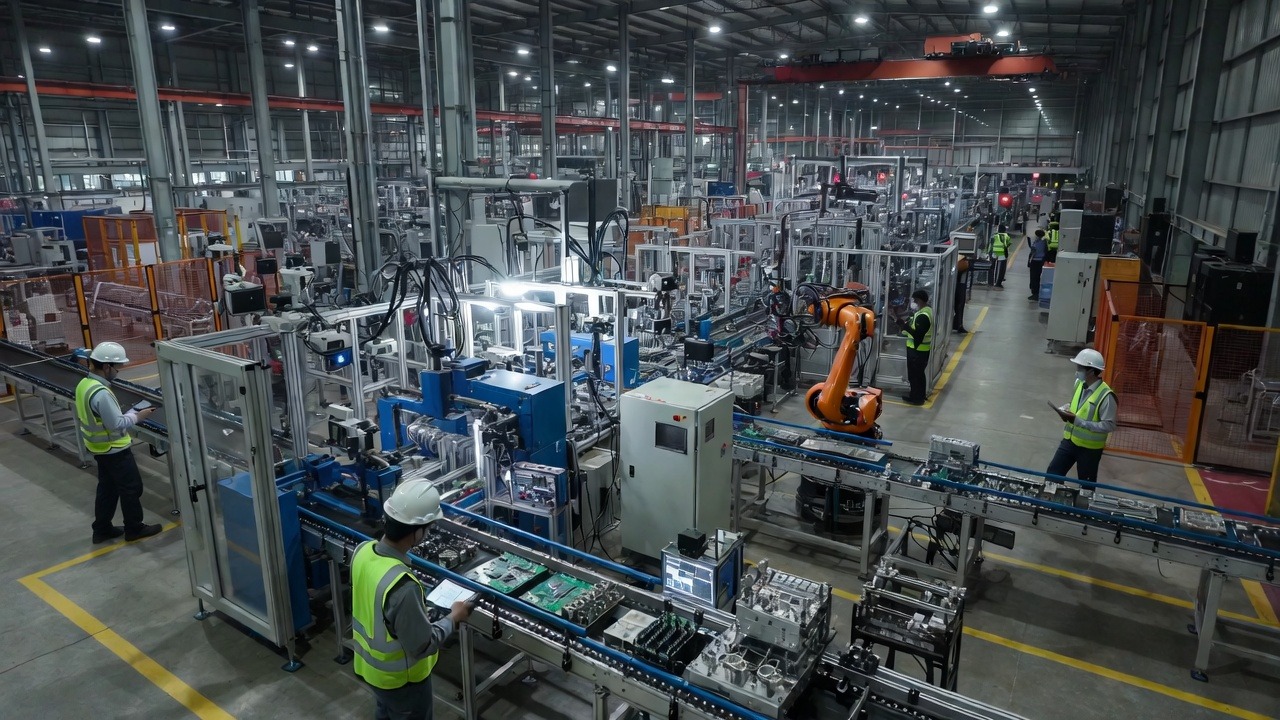
 Hero image: Wide shot of a modern Indonesian factory production line with automated AI inspection station
The Uncomfortable Truth About Manual QC
Walk into any mid-size food or beverage factory in the Cikarang-Karawang industrial corridor and you'll see the same setup. At the end of a high-speed conveyor belt, two or three inspectors sit on stools, watching an endless stream of bottles, sachets, or cartons fly past. Their job: spot the bad ones. Crooked cap. Torn seal. Missing label. Wrong print.
These inspectors are doing their best. But here's the thing — the human eye wasn't designed for this. Research across manufacturing environments consistently puts manual visual inspection accuracy at around 80%, and that number drops further after the second hour of a shift. Fatigue, distraction, and the sheer monotony of staring at identical products create an invisible ceiling on quality.
For a line running 1,000 pieces per minute, even a 2% miss rate means 20 defective products pass through every single minute. Over an 8-hour shift, that's nearly 10,000 defective units entering the supply chain. Some of those will become customer complaints. Others become recalls. A few will become negotiations with your biggest retail partner about why their shelves had unsealed product.
The real cost isn't just the defective product. It's the batch that gets held at the distributor's warehouse. It's the emergency production run to cover the shortage. It's the procurement manager who starts looking at your competitor's catalog.
This isn't a hypothetical scenario. This is Tuesday at thousands of factories across Indonesia.
What's Changed: Computer Vision Gets Practical
The idea of using cameras and software to inspect products isn't new — traditional machine vision has been around since the 1980s. But those systems were rigid. They relied on hand-coded rules: "if pixel brightness at coordinate (x, y) is below threshold, reject." Every new product, every lighting change, every slight variation in packaging material meant reconfiguring the rules.
What changed in the last five years is the accessibility of deep learning for visual tasks. Convolutional neural networks (CNNs) — and more recently, architectures like YOLO (You Only Look Once) and RT-DETR — don't need hand-coded rules. They learn from examples. Show the model 200 images of correctly sealed caps and 50 images of defective ones, and it learns to tell the difference on its own.
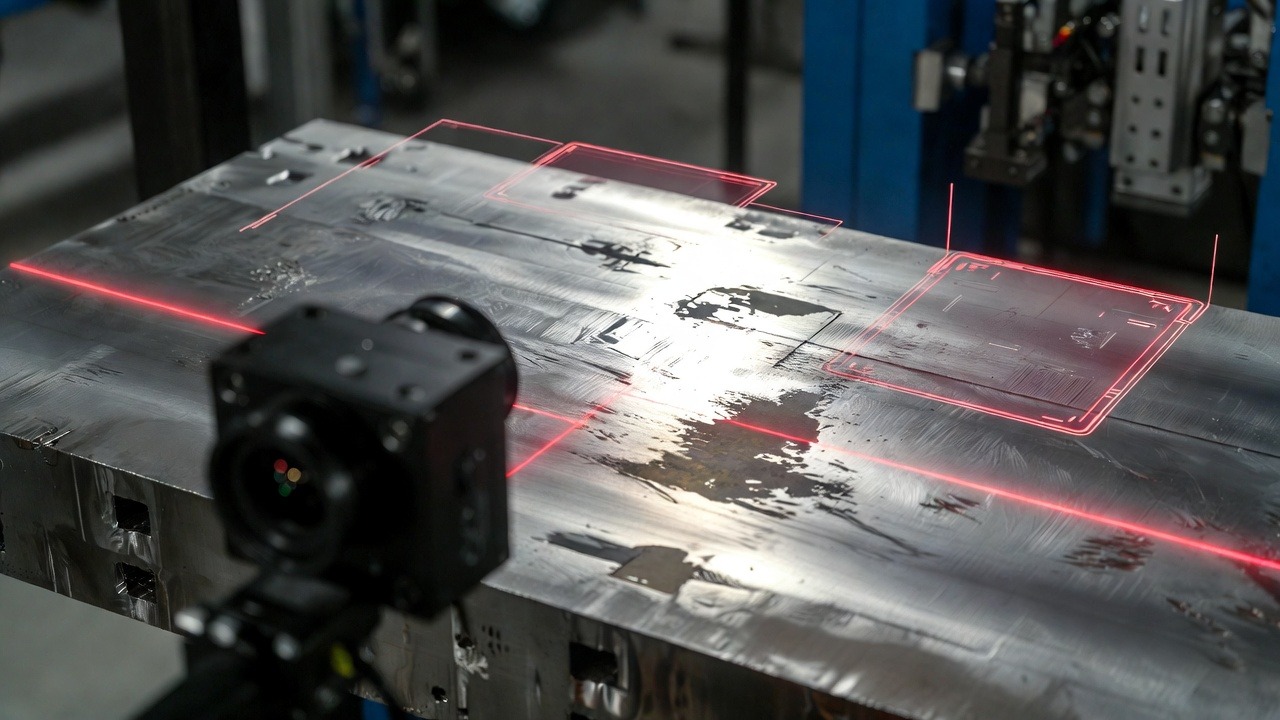
This is significant because it fundamentally changes the deployment model. Instead of weeks of rule-tuning by a specialized vision engineer, you can train an initial model in days with a representative image dataset collected from your actual production line. The model handles variation — different lighting conditions throughout the day, slight color shifts between material batches, normal wear patterns on the conveyor — that would break a rule-based system.
What Can AI Actually Inspect?
There's a misconception that AI visual inspection is a single capability. In practice, it covers a range of distinct tasks, each with different technical requirements and business value. Here are the ones we see making the biggest impact in Indonesian manufacturing:
Surface Defect Detection
Scratches, dents, discoloration, bubbles, cracks — any anomaly on the product surface. This is where AI particularly shines, because many surface defects are subtle and variable. A scratch on a metal component can appear anywhere, at any angle, at any size. Rule-based systems struggle with this variability. Anomaly detection models (like PatchCore or EfficientAD) can be trained on only "good" product images and will flag anything that deviates from learned normalcy.
Packaging Integrity
Cap alignment, seal integrity, fill level, shrink wrap completeness. On a high-speed bottling line doing 800-1,200 bottles per minute, every unit needs to pass. AI handles this with object detection models that verify each checkpoint in under 50 milliseconds — fast enough that the bottle doesn't even need to stop.
Component Completeness
Think of an instant noodle pack: noodle block, seasoning, chili oil, garnish, and sometimes a promotional insert. Five components. Before the pack is sealed, AI verifies all five are present and correctly positioned. This same approach applies to electronic kits, cosmetic bundles, or any multi-component assembly.
OCR and Code Verification
Production dates, batch codes, expiry dates, barcodes. AI reads them, cross-references against the expected values for the current production run, and flags mismatches. This is particularly critical for pharmaceutical and food manufacturers where wrong-date product can trigger regulatory action.
Foreign Object Detection
Hair, insects, plastic fragments, metal shavings. Contaminants that metal detectors can't catch but cameras can see. For food and pharma manufacturers in Indonesia, where BPOM compliance requires documented contamination prevention, this capability fills a real gap.
Sorting and Grading
AI doesn't just pass/fail — it can grade. Fruits sorted by ripeness and size for export. Metal castings graded by surface quality. Ceramic tiles classified by color consistency. This turns the inspection station into a value-adding step that improves product segmentation and pricing.
The Numbers That Matter
So what actually happens to the numbers when you deploy an AI-based system? Based on industry benchmarks and documented deployments across manufacturing environments:
The accuracy jump — from roughly 80% with manual inspection to 99.5%+ with AI — sounds abstract until you translate it to your production volume. On a line producing 500,000 units per day, that difference means approximately 97,500 fewer defective units entering your supply chain per day. Over a year, the defect reduction alone often pays for the entire system within 8 to 14 months.
But the second-order effects matter just as much. Every inspection generates data. You now have a searchable record of every defect, timestamped, categorized, and linked to the production batch. When your QC manager asks "why did we have a spike in cap misalignment on Tuesday afternoon?", the system has the answer — often correlating it with a specific material batch, machine setting, or shift change.
Why Indonesian Manufacturers Should Pay Attention Now
There's a timing argument here that goes beyond technology readiness. Three things are converging:
Export quality requirements are tightening. Manufacturers exporting to Japan, Korea, Europe, and Australia are facing increasingly stringent quality documentation requirements. A signed inspection report from a human QC officer is no longer sufficient for many buyers. They want digital traceability — timestamped, image-based evidence that every unit passed inspection. AI visual inspection generates this automatically.
Labor dynamics are shifting. Finding reliable, experienced QC inspectors is getting harder and more expensive, particularly in the Jabodetabek and East Java industrial areas. AI doesn't replace your QC team — it extends their capability. One inspector overseeing an AI system can effectively monitor what used to require five to eight manual inspectors, and with higher consistency.
The technology cost has dropped dramatically. Five years ago, deploying computer vision on a production line required a custom-built system from a European or Japanese integrator, with price tags starting at Rp 2-3 billion for a single line. Today, purpose-built AI inspection platforms can be deployed on edge devices at a fraction of that cost, with training and deployment timelines measured in weeks rather than months.
The early adopters in your industry segment will build inspection datasets, refine their models, and achieve quality levels that become the new baseline. The question isn't whether AI visual inspection will become standard — it's whether you'll be the one setting that standard or catching up to it.
The Gap Between Demo and Production
A word of caution that we think is important to share honestly: getting a demo to work is easy. Getting a production-grade system that runs reliably at full line speed, 24/7, across seasonal product variations and changing factory conditions — that's the hard part.
Here are the real-world challenges that separate a proof-of-concept from a deployed system:
- Lighting consistency. Factory lighting changes throughout the day. Natural light from windows, fluorescent flicker, shadows from operators moving around the line. A robust system needs controlled illumination at the inspection station, and the model needs to be trained on the actual lighting variance it will encounter.
- Line speed matching. Your camera, trigger system, and inference pipeline need to keep up with the conveyor. At 1,000 pcs/min, you have roughly 60 milliseconds per product. If your model takes 80ms, you're missing every third item. Hardware-software co-design isn't optional.
- Edge cases and model drift. Seasonal packaging changes. A new supplier for cap material that's slightly different in color. A production run of a limited-edition SKU. The model needs to handle these gracefully, and you need a system for updating it when it encounters new scenarios.
- Integration with rejection mechanisms. Detection is only half the system. The other half is actually removing the defective product from the line — pneumatic pushers, diverter gates, robotic arms. The timing between detection and physical rejection needs to be precise.
This is why we believe the winning approach for Indonesian manufacturers isn't buying an off-the-shelf global platform and hoping it works. It's working with a team that understands local factory conditions — the humidity, the dust, the power fluctuations, the specific products and packaging materials used in this market — and can tune the system to perform reliably in your environment, not a sterile demo lab.
Getting Started: A Practical Framework
For manufacturing leaders considering AI visual inspection, here's the approach we've seen work best:
Start with your highest-pain-point inspection station. Don't try to automate everything at once. Identify the single inspection point where defect escape costs you the most — financially, reputationally, or in compliance risk. Deploy there first, prove the ROI, then expand.
Collect real production data early. Even before selecting a system, start collecting images from your production line. Good images. Bad images. Edge cases. The quality and representativeness of your training data determines 80% of your model's performance. Start building this dataset now.
Define success metrics before deployment. "Better quality" isn't a metric. Define the current reject rate, the target reject rate, the acceptable false positive rate (good products incorrectly rejected), and the latency requirement. These numbers guide every technical decision.
Plan for continuous improvement. The model you deploy on day one is not the model you'll be running six months later. As it encounters new defect types, new product variations, and edge cases, the model needs to be updated. Build this maintenance cycle into your operational plan from the start.
Looking Ahead
The trajectory of AI visual inspection in manufacturing isn't slowing down. We're seeing the convergence of several trends that will make the next two to three years transformative: edge computing costs continuing to drop, pre-trained foundation models reducing the data needed for custom deployments, and — perhaps most importantly — growing acceptance among factory operators that AI is a tool that works with them, not against them.
For Indonesian manufacturers competing in both domestic and export markets, the opportunity window is open. The factories that invest in intelligent inspection now won't just reduce their defect rates. They'll build the data infrastructure for continuous quality improvement — a compounding advantage that grows with every production run.
The best time to start was yesterday. The second best time is today.
Frequently Asked Questions
AI visual inspection systems typically achieve 99.5%+ accuracy, compared to approximately 80% for manual human inspection. The gap widens further on high-speed lines above 500 pcs/min where human fatigue becomes a major factor.
A typical deployment takes 2-6 weeks, depending on the complexity of the inspection task and whether custom model training is required. Simple pass/fail inspection can be deployed in under 2 weeks, while multi-class defect classification may take 4-6 weeks including data collection and model training.
Most manufacturers see ROI within 8-14 months through reduced defect escape costs, lower rework rates, and decreased reliance on manual inspection labor. Factories with high defect-related costs (recalls, customer penalties) often achieve ROI faster.
Yes. AI visual inspection systems are designed to integrate with existing conveyor infrastructure. An industrial camera and edge computing device are mounted at the inspection point — no mechanical modifications to the production line are required.
AI can detect surface defects (scratches, dents, discoloration), packaging issues (misaligned caps, torn seals, incorrect fill levels), missing components, foreign objects, label errors, and OCR verification (production codes, expiry dates, barcodes). The system can be trained for virtually any visually identifiable quality parameter.
See How It Works on Your Production Line
We offer a free assessment to evaluate your inspection challenges and demonstrate how AI visual inspection can impact your specific production environment.
Request Free Assessment